Schema Therapy Curriculum
Schema Therapy Curriculum – ST1–ST3
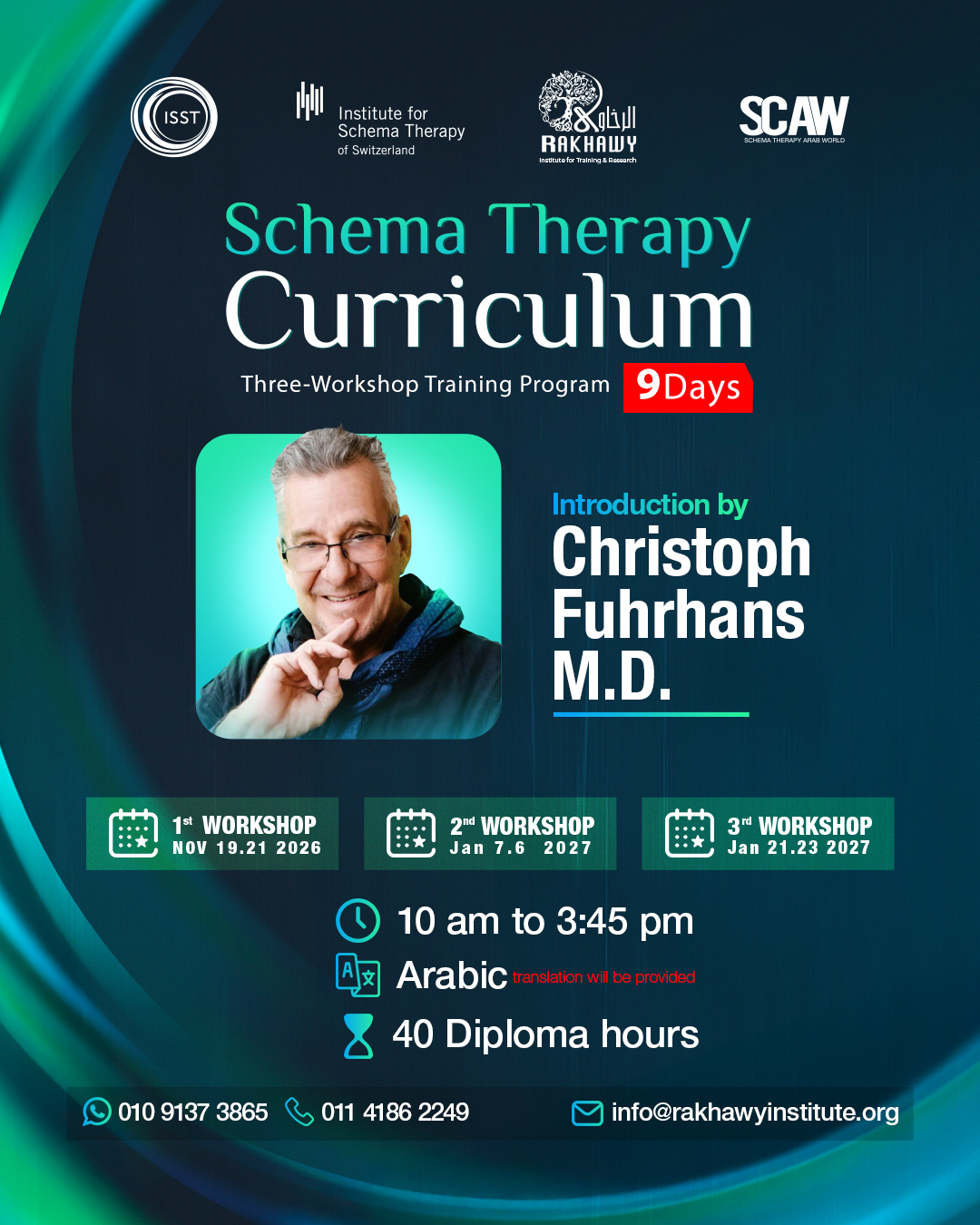
Three-Workshop Training Program (9 Days Total)
Organized by
Rakhawy Institute for Training and Research (RITR)
International Society of Schema Therapy (ISST)
Schema Therapy Institute East Switzerland (ISTOS)
Leading to
Schema Therapy Diploma for Arabic-Speaking Professionals
Training Schedule
- First Workshop: November 19 – 21, 2026
- Second Workshop: January 7–9, 2027
- Third Workshop: January 21–23, 2027
- Time: 10:00 AM – 3:45 PM
Total Training Hours: 40 hours
The certification process is only possible if participants attend all three workshops.
At the completion of the 40 training hours, participants receive an accredited diploma in Schema Therapy from the International Society of Schema Therapy (ISST).
This diploma represents the first step toward becoming an ISST Certified Schema Therapist.
The next step is completing the required supervision hours.
Instructor:
Christoph Fuhrhans, M.D. (Switzerland)
Dr. Christoph Fuhrhans studied medicine, philosophy, art history, and comparative literature in Kiel, Vienna, and Berlin.
As a psychiatrist and psychotherapist, he worked as a DBT trainer and, since 2008, as a Schema Therapist, Schema Therapy trainer, Group Schema Therapy trainer, and ISST-certified supervisor.
He is the founder and director of the Schema Therapy Institute East Switzerland (ISTOS) and President of the Swiss Schema Therapy Network.
He has delivered international presentations and trainings and leads Schema Therapy certification programs in:
- Palestine (since 2018)
- Egypt (since 2020)
- Tunisia (since 2022)
His main areas of interest include psychotherapy and cultural sciences, current developments in psychotherapy (especially trauma therapy), and Schema Therapy in Arab countries.
He lives and works in Winterthur, Switzerland.
What is Schema Therapy?
Schema Therapy is an integrative psychotherapeutic approach developed by Jeffrey E. Young. It was originally designed for personality disorders and severe Axis I disorders, particularly for clients who did not respond sufficiently to standard treatments such as CBT.
It integrates cognitive-behavioral therapy with humanistic, attachment-based, interpersonal, and psychoanalytic elements into one unified model.
Research evidence, including controlled studies and a meta-analysis (Arntz et al.), has demonstrated that Schema Therapy produces significantly better outcomes and substantially lower dropout rates compared to other inpatient and outpatient psychotherapies.
At its core, Schema Therapy focuses on unmet childhood emotional needs. When these needs are repeatedly unfulfilled, children develop maladaptive schemas—deeply rooted patterns of beliefs, emotions, and expectations about themselves and the world.
Activated parts of schemas are called Modes.
Through a close therapeutic relationship based on Limited Reparenting, the therapist helps clients gradually meet their unmet emotional needs. Techniques such as Imagery Rescripting support clients in healing traumatic childhood experiences and reducing the dominance of dysfunctional coping modes.
Program Structure
The curriculum consists of three foundational workshops (ST1–ST3), each lasting three days (total 9 days / 40 hours).
Participants may register for individual workshops or for the complete curriculum.
However, full attendance of all three workshops is required for certification eligibility.
Workshop Overview
Workshop 1
Introduction to Schema Therapy
Topics include:
- History and foundations of Schema Therapy
- Basic emotional needs
- Development and maintenance of Early Maladaptive Schemas (EMS)
- The 18 maladaptive schemas
- Introduction to the Mode Model
- Overview of intervention techniques
- Case conceptualization
Detailed Structure
Day 1:
Basic emotional needs and the development and maintenance of EMS.
Day 2:
The Mode Model: Child Modes, Punitive Modes, and Dysfunctional Coping Modes. Identification and clinical application.
Day 3:
Positive schemas and case conceptualization.
Methods:
PowerPoint presentations, master role-plays, small group exercises, video demonstrations, handouts.
Workshop 2
Mode Work I – Imagery, Chair work & Mode Dialogues
- Imagery and Imagery Rescripting
- Timing and clinical application
- Overcoming obstacles
- Positive and resource-oriented imagery
- Chair work techniques
- Emotional activation and change processes
Participants practice techniques in small groups.
Workshop 3
Therapeutic Relationship & Schema Therapy for Personality Disorders
Focus on:
- Limited Reparenting
- Empathic Confrontation
- Limit Setting
- Working with Cluster C, Narcissistic, and borderline personality disorders
- Finalizing case conceptualization
Participants learn how Schema Therapy offers advantages over traditional approaches for severe personality disorders.
Curriculum Content (ISST Requirements)
The ISST requires 40 hours of basic training:
- 25 hours didactic
- 15 hours dyadic practice
- Concept & Case Conceptualization
Schema theory, coping styles, modes
Assessment methods
Treatment formulation
- Therapeutic Relationship
Limited Reparenting
Empathic Confrontation
Limit Setting
Therapist schemas
- Techniques
Cognitive techniques (diaries, flashcards)
Experiential techniques (imagery, chair work, mode dialogues)
Homework and behavioral change strategies
- Specific Populations
BPD (required)
Cluster C (required)
NPD
Other personality disorders
Axis, I disorder (addiction, eating disorders, PTSD, OCD – optional)
- Literature
- Reinventing Your Life
- Schema Therapy: A Practitioner’s Guide
- Additional readings
ISST Certification Requirements
To obtain the ISST Standard Certification Diploma:
- 40 hours training
- 20 hours supervision
- Written case conceptualization (minimum score 4.0)
- Video session rating (minimum score 4.0)
- ISST membership
Registration Fees
Early Bird (before October 30, 2026)
- Single: 21,500 EGP
- Groups (3):20000 EGP per person
- Non-Egyptians: 750 USD
Late Registration (after October 30, 2026)
- Single: 23,000 EGP
- Groups (3+): 21,500 EGP per person
- Non-Egyptians: 750 USD
Payment in Two Installments Available
- First installment: before October 20, 2026
- Second installment: before 10 January 2026
For registration, please submit your application through the official registration link.
Speaker
-
 Christoph FuhrhansSchema Therapy trainer and supervisor (ISST).
studied medicine, philosophy, art history and comparative literature in Kiel, Vienna and Berlin. As a psychiatrist and psychotherapist he works since 2008 as Schema Therapist, Schema Therapy trainer and supervisor (ISST).
He is the founder and leader of the “Schema Therapy Institute East Switzerland” and president of the Swiss Schema Therapy Network.
International presentations and trainings, leader of the Schema Therapy certification training programs in Palestine (since 2018), Egypt (since 2020) and Tunisia (since 2022).
His major regions of interest are psychotherapy and cultural sciences, current developments of psychotherapy (especially trauma therapy) and Schema Therapy in Arab countries.
He lives in Winterthur/Switzerland and works in his private practice.