Child and Adolescent Curriculum of Schema Therapy (ST-CA)
Rakhawy Institute for Training and Research (RITR)
International Society for Schema Therapy (ISST)
Schema Therapy Institute East Switzerland (ISTOS)
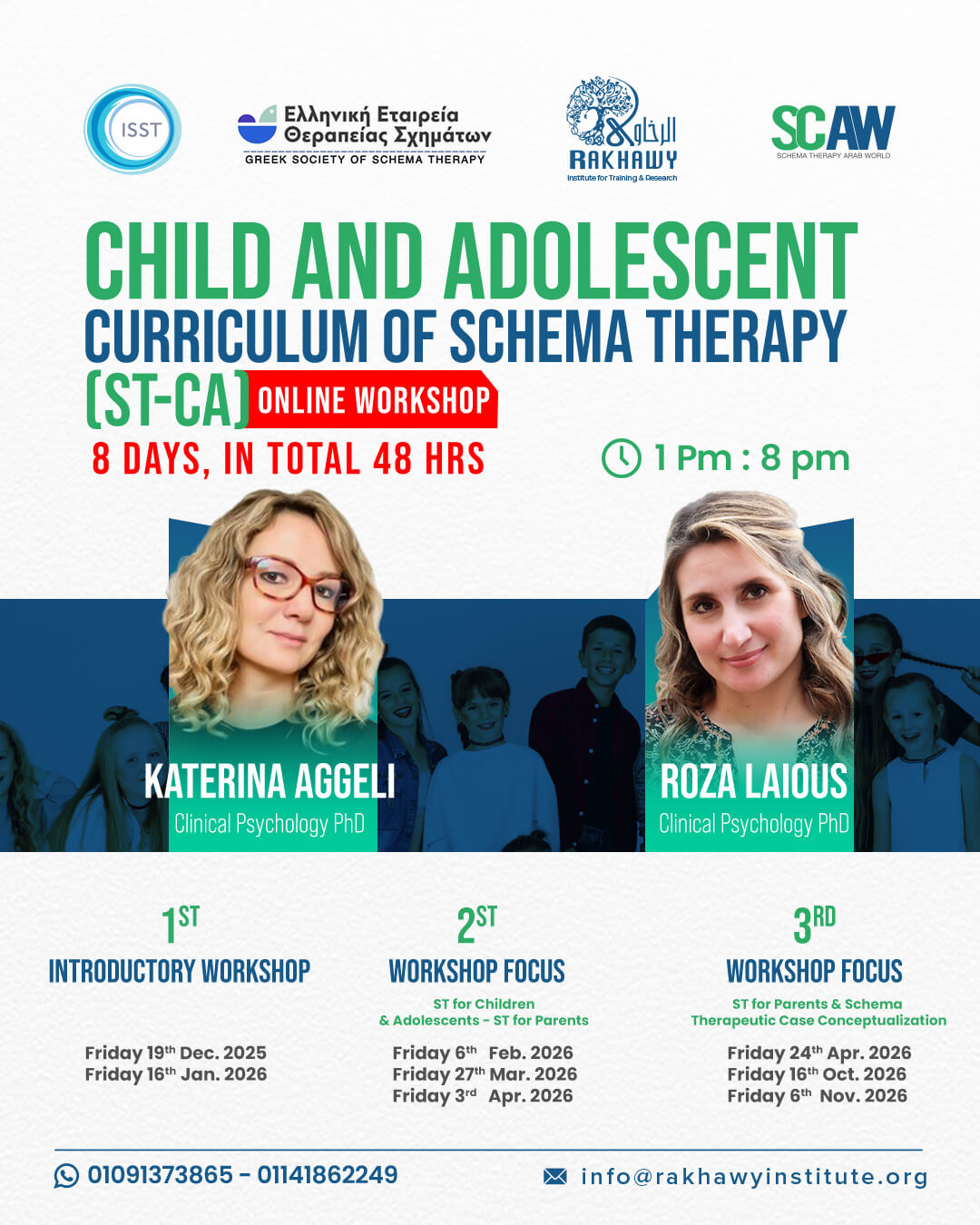
Child and Adolescent Curriculum of Schema Therapy (ST-CA)
(8 days, in total 48 hrs) (Online Workshop)
Date:
1st Introductory workshop
Friday 19th December 2025
Friday 16th January 2026
2nd Workshop focus: ST for Children & Adolescents – ST for Parents
Friday 6th February 2026
Friday 27th March 2026
Friday 3rd April 2026
3rd Workshop focus: ST for Parents & Schema Therapeutic Case Conceptualization
Friday 24th April 2026
Friday 16th October 2026
Friday 6th November 2026
Time:
13:00 PM – 20:00PM
About workshop:
Schema Therapy (ST) developed by Jeffrey Young is an enhancement and further development of cognitive behavioral therapy as well as psychodynamic psychotherapy, and particularly integrates emotions, but also developmental aspects centrally in their diagnostic and therapeutic considerations. In addition, ST is based on a model of schemas, modes and the basic needs and “their fate” during the life course. Therefore, ST – as an integrated approach with cognitive-behavioral, psychodynamic, and developmental roots – seems to be also and especially in the field of child and adolescent therapy particularly suited to generate action-guiding, diagnostic and therapeutic concepts.
In total 8 workshop days of the “Children’s Curriculum”, first the schema therapeutic conceptual model (schemas, modes, coping strategies), the underlying theory (central importance core needs in the context of developmental tasks), possible diagnostic means (eg, projective methods) and requirements in the therapeutic attitude (eg, concept of “limited reparenting” and “empathic confrontation”) are outlined, put on the ground of temperament and personality factors in childhood and adolescence. However, in the center of the workshop series are training and practice units, encompassing schema therapeutic strategies that have proven successful in childhood and adolescence. Another focus is laid on the teaching of advanced and deepened work with parents in terms of “Schema Coaching” or “Systemic Schema Therapy“ that include schema or mode specific transactional processes between child and parent and shed a light on mutual reinforcement’s processes of child’s und parent’s maladaptive schemas. Last but not least the basic principles of ST-CA in groups are outlined.
| Workshop‘s Name | total | didactic | dyadic | |
| ST-CA Days
1 – 2 |
Children’s Curriculum Workshop 1 Introductory Workshop | 12hrs* | 9 hrs | 3 hrs |
| ST-CA Days
3 – 5 |
Children’s Curriculum Workshop 2 Focus: ST for Children & Adolescents; ST for Parents (1) | 18 hrs | 12 hrs | 6 hrs |
| ST-CA Days
6 – 8 |
Children’s Curriculum Workshop 3 Focus: ST for Parents (2) and Schema Therapeutic Case Conceptualization | 18 hrs | 12 hrs | 6 hrs |
| In total | 48 hrs | 33 hrs | 15 hrs |
* 1 hour =60 minutes
Child and Adolescent Curriculum in ST-CA
Child and Adolescent Curriculum Unit 1 (“Introductory Unit”)
2 days, 12 hours, 60 min each (16 TU – teaching units, 45 min each)
The introductory workshop illuminates the formation and perpetuating model of maladaptive schemas against the background of age-specific developmental tasks, risk and protective temperamental factors. Related to the children’s age the 18 schemas described by Young are outlined with their typical child and adolescent appearance and coping strategies. Other topics include the multimodal diagnostic techniques (use of exploration, survey, imagery, case conceptualization) and explain the significance of the therapeutic relationship, psychoeducation and empathic confrontation.
Review of the contemporary concepts and research results on the Physical, Cognitive and Social-Emotional Development of both Children and Adolescents provides a wider understanding of the manifestation of needs and emotional reactions in young patients.
As an overview therapeutic strategies are demonstrated: Working with drawings and pictures, mode-based play therapy, working with stories, finger and hand puppets, metaphors, chair work, imagery, templates, the use of flash cards and homework.
An important part of the introductory workshop is to work with parents, which is also outlined in an overview. Contents are typical parental mode constellations, mode cycle flash cards, investigation of parental schemas and modes, and the practical implementation in mode work with parents (working with chairs, templates, wooden figures, drawings, etc.).
Beside the introductory in schema theory the workshop offers many practical demonstrations by picture and video material, and small exercises allow the participants transferring the content into their own practice.
Child and Adolescent Curriculum Unit 2
3 days, 18 hours, 60 min each (24 TU – teaching units, 45 min each)
Focus: Children and Adolescents (12 hrs, 16 TU) and Schema-Coaching for Parents (6 hrs, 8 TU)
This unit of 3 days is based upon the content of the introductory unit (WS 1), whose participation is a prerequisite for the immersion workshops (WS 2 to 3).
Exception: Participants, who attended an 2-day introductory course for adult’s Schema Therapy (Individual) or any ST course equivalent to this, can join in directly in the children’s curriculum with unit 2 here.
The goal of this unit is to learn the techniques of schema therapy with children and adolescents specifically. Additionally, there will be an introduction into the work with parents. Special attention is paid to the specific problems facing adolescents today: suicide as the 2nd cause of deaths in adolescents, alcohol, drugs, unprotected sex, eating disorders, gender dysphoria, bullying, cyber bullying, peer pressure, etc. Also important to separate maturational issues from behavioral problems.
Note:
Arabic translation will be available during the training to facilitate understanding and participation for all attendees.
Exception: Participants who have attended a two-day introductory course in psychodrama for adults, or an equivalent course, may join this module directly.
Registration Fees
Early Registration (before December 6):
- Egyptians:
- Individual: 8 training days – $700, 6 training days – $580
- Groups of 3 participants: 8 training days – $650, 6 training days – $530
- Non-Egyptians:
- Individual: 8 training days – $800, 6 training days – $670
- Groups of 3 participants: 8 training days – $745, 6 training days – $625
Late Registration (after December 6):
- Egyptians:
- Individual: 8 training days – $750, 6 training days – $640
- Groups of 3 participants: 8 training days – $700, 6 training days – $595
- Non-Egyptians:
- Individual: 8 training days – $900, 6 training days – $800
- Groups of 3 participants: 8 training days – $840, 6 training days – $745
Payment Information for the Workshop:
To facilitate registration and participant convenience, the payment system is as follows:
- For Egyptian participants:
- First installment: Paid in Egyptian Pounds upon registration, calculated based on the USD exchange rate on the day of payment.
- Second installment: Paid in USD before the start of the third workshop.
- Payment division: The total fee is split equally between the two installments.
- Note: Participation in the third workshop is not allowed without completing the second installment.
- For non-Egyptian participants:
- Full payment in USD.
- The amount may be divided into two equal installments if needed.
- Pricing:
- Workshop fees are determined according to early registration before December 6 and late registration after December 6, for both Egyptian and non-Egyptian participants, individually or in groups of 3.
For more information:
WhatsApp: 01091373865
Tel: +20225080818 / +20226677740
E-mail: info@rakhawyinstitute.org
Child and Adolescent Curriculum in ST-CA
After a brief connection with the schema theoretical introduction and sharing of some experiences in practice (WS 1), the focus will be laid on the features of the particular therapeutic relationship, including the concepts of limited reparenting, empathic confrontation and practical working with the special schema therapeutic techniques.
Video examples and role-play in groups of two or three participants ensure the consolidation and deepening of what has been learnt. In particular, the content and methods are:
- Working on close relationships with children and adolescents
- Working with finger and hand puppets
- Imagery
- Use of flash cards and homework
- Working with storytelling (e.g. ‘stem stories)
The first part of the parental work includes:
- Therapeutic relationship with parents: “Limited Grandparenting”
- Investigation of parental resources, needs and family structures
- Testing of questionnaires
- Education of the schema and mode concept in the context of parenting with exercises in groups
Beside the features of schema theory the workshop offers many practical demonstrations by picture and video material, and small exercises allow the participants transferring the content into their own practice.
Child and Adolescent Curriculum Unit 3
3 days, 18 hours, 60 min each (24 TU – teaching units, 45 min each)
Focus: Schema-Coaching for Parents, Case Conceptualization and more specific techniques
This unit is based upon the content of the introductory and immersion workshop (unit 1 and unit 2), whose participation is a prerequisite for this immersion unit (WS 3).
The goal of this unit is to learn the techniques of schema therapy with parents (continuation of unit 2) and to apply the schematic therapeutic approaches to their own cases. After a brief connection with the theory of unit 1 and unit 2, the focus will be laid on the features of the work with parents including practical exercises. The parental mode work with chairs, finger puppets, templates, imagery, schema and mode flash card, internal dialogue and schema diary are the central point of the first day of unit3.
The second part of the parental work includes: (first part was in WS 2):
- Creating a schematic therapeutic and systemic disturbance model
- Adjustment of the parental schemas and modes
- Mode feedback among family members
- Collusion of schemas and modes among the therapist and the patient (child/parents)
- Usage of parental Mode-Cycle-Clash-Cards
Child and Adolescent Curriculum in ST-CA
Case Conceptualization:
Case studies of the participants and role play in groups of two or three participants ensure the deepening of what has been learnt. After the case presentation in the plenary, participants work out in small groups the schema therapeutic case concept and treatment plan to this patient and his family. Based on already implemented schematic therapeutic treatment techniques progress and problems in the used interventions are discussed. In the last unit participants will learn, how to follow the schema therapeutic approaches in the context of self-awareness, self-disclosure and supervision groups.
The following content (including practice) will be covered in the second and third day of this workshop:
- Illustration of the basic approach to case conceptualization
- Conceptualization and treatment planning for their own cases
- Schema therapeutic supervision, self-experience and certification
- Special problems in the therapy
- Mode-oriented play therapy
- Working on the “Inner House”
- Working with therapeutic board games
- Application of art-therapy techniques
- Basics of ST-CA in Groups (e.g. Training in Self-Assertiveness)
LITERATURE:
SCHEMATHERAPY FOR CHILDREN AND ADOLESCENTS:
Lockwood, G. & Shaw, I.A. (2012). Schema Therapy and the Role of Joy and Play. In M. van Vreeswijk, M. Nadort & J. Broersen (Eds) Handbook of Schema Therapy. Wiley-Blackwell.
Loose, C., Graaf, P. & Zarbock, G., Holt, R (2013). Schema Therapy for Children and Adolescents. Weinheim: Beltz.
SCHEMATHERAPY FOR ADULTS:
Arntz, A. & Jacob, G. (2012). Schema Therapy in Practice: An Introductory Guide to the Schema Mode Approach. John Wiley & Sons.
Farrell, J.M., Reiss, N., & Shaw, I.A. (2014). The Schema Therapy Clinician’s Guide: A Complete Resource for Building and
Delivering Individual, Group and Integrated Schema Mode Treatment Programs. John Wiley & Sons. Rafaeli, E., Bernstein, D.P., & Young, J. (2011). Schema Therapy (CBT Distinctive Features). Taylor & Francis. Vreeswijk, M. van, Broersen, J. & Nadort, M. (2012). The Wiley-Blackwell Handbook of Schema Therapy: Theory,
Research and Practice. John Wiley & Sons
Young, J., Klosko, J. & Weishaar, M. E. (2006). Schema Therapy: A Practitioner’s Guide. Guilford Pubn. SCHEMATHERAPY FOR GROUPS:
Farrell, J.M. & Shaw, I.A. (2012). Group Schema Therapy for Borderline Personality Disorder: A Step-by-Step Treatment Manual with Patient Workbook. John Wiley & Sons.
Trainers:
Katerina Aggeli is a Clinical Psychology PhD. She is a certified therapist in CBT (Greek Society of Behaviour Research) and ST for Adults and Children and Adolescents (Advanced level, ISST). She is a member of the Board, trainer and supervisor at both the Greek Association of Cognitive and Behavioural Studies and the Greek Association of Schema Therapy. She is also a lecturer in the University of Athens, in the post-graduate Clinical Psychology curriculum and a Master Trainer in the Mental Health Initiative for Children and Adolescents of the Stavros Niarchos Foundation Institute, in collaboration with the Child Mind Institute of New York. She initiated the psychotherapy book series “Sketch it out loud”.
Roza Laious is PhD. Clinical Psychologist, Certified Cognitive Behavioral Therapist & Advanced Schema Therapist, Supervisor & Trainer for Children, Adolescents & Adults. Moreover, she is Scientific Associate, Research Supervisor & Trainer in the training program module CBT for Children & Adolescents, Department of Child & Adolescent Therapy of the Institute of Behavioral and Research Therapy (IBRT), Athens.
Her clinical and psychotherapeutic work includes Schema Therapy- based psychoeducational groups for children and parents based on her PhD research program, individual Cognitive and Behavioral Therapy & Schema Therapy.